

The Native American Studies (NAS) program of the Ethnic Studies Department celebrates Women’s History Month and is proud to present this beautiful exhibit entitled, “Honoring Native American Women: Past, Present, and Futures.” This exhibit highlights the important roles of Native American women in shaping their tribal nations, preserving cultural traditions, and leading social and political movements. Each of the three cases highlights different Native American women, leaders, artists, and their contributions across history and today.
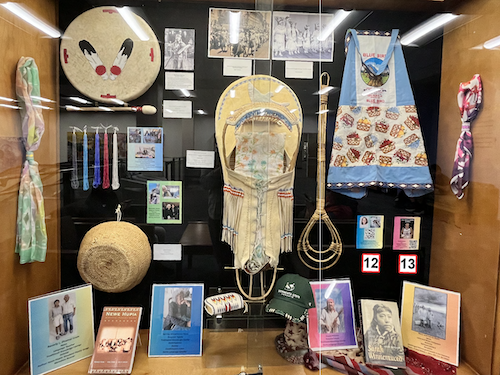 The left case is dedicated to Native American women who have broken barriers in their respective career fields, dedicated their lives to revitalizing cultural practices, languages, songs, dances, and community, but also dedicated their lives to land protection, advocating for tribal rights, and practicing sovereignty through defiance. Most of the women in this case are from the Great Basin: Mary and Carrie Dann (the Dann Sisters), ranchers turned activists, who challenged the federal government/BLM in the Supreme Court in protection of Western Shoshone treaty rights; Beverly Crum, a Western Shoshone language teacher, author, scholar, and traditional knowledge carrier whose contribution to language documentation and revitalization preserved Shoshone language and songs for future generations; Sarah Winnemucca, a Paiute educator, author, and activist who advocated for the Northern Paiute people during warfare and encroachment in the mid-to-late 19th century; and traditional knowledge carriers like Bernita Winnemucca Teton, Gussie Williams, Janine "Heidi" Barlese, Reynelda James, Avis Dunn, and Lulu Jim (all Northern Paiute) whom have nurtured, preserved, revitalized, and continued Paiute culture, language, and songs. Bernita, Avis, Lulu, and Gussie contributed their artistry and talent to the creation of physical items displayed like the Paiute/Shoshone cradleboard, beautiful beadwork, the hand drum, and basketry.
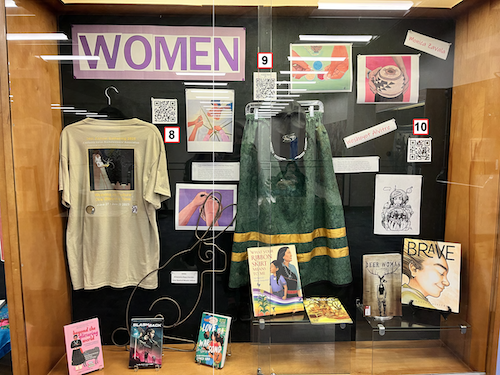 The middle case is dedicated to Native American women who have excelled in the arts. Highlighted in this case are prominent Native artists and authors as well as books about extraordinary Native women. Enjoy the art and read the brief biographies including local Native women tribal government leaders and some of the “firsts,” including the first all-women tribal council at the Agua Caliente Cahuilla reservation in the 1950s and Alice Piper whose family challenged California’s segregated schools in 1924. There is also a ribbon skirt, kokum scarf, children’s books, comic, and t-shirts from the NDN Girls Book Club and annual California Indian Basketweavers Association.
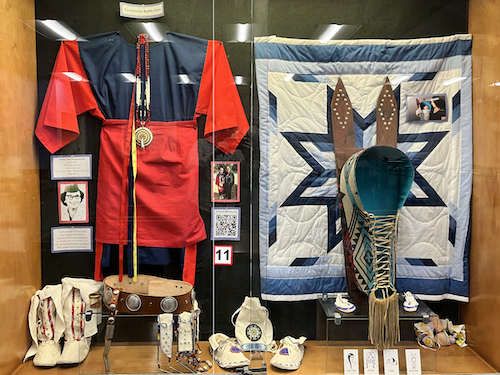 The right case is dedicated to honoring Comanche women. Highlighted in this case is a Comanche Battle Dress along with its accompanying regalia traditionally worn by Comanche women to honor our military veterans. Visitors will have an opportunity to hear the Comanche Veteran’s Song and learn more about Theresa Asepermy-Pilas, an Air Force veteran who gave her granddaughter the right to wear the Comanche Battle Dress. In addition, to honor motherhood, visitors can see a Comanche Cradleboard that Comanche women used to keep their babies safe. There are baby moccasins that were created for a newborn as well as a gifted Star Quilt. Cards are included that provide an opportunity for visitors to learn some Comanche words: woman, girl, baby, and cradleboard. Finally, there are 3 bags of traditional perfume that Comanche women once used.
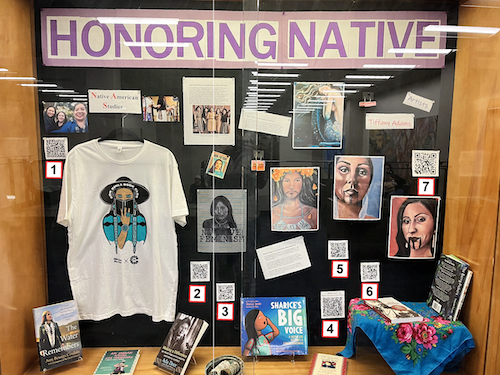 In this exhibit, we welcome our visitors to explore the various QR codes that provide further context into the different individuals and items. It is our hope that this exhibit will inspire conversations, recognition, and honor the legacy of these extraordinary women and the future generations.